
Low-Tech Aquarium: Complete Guide
How to create a beautiful aquarium with minimal effort
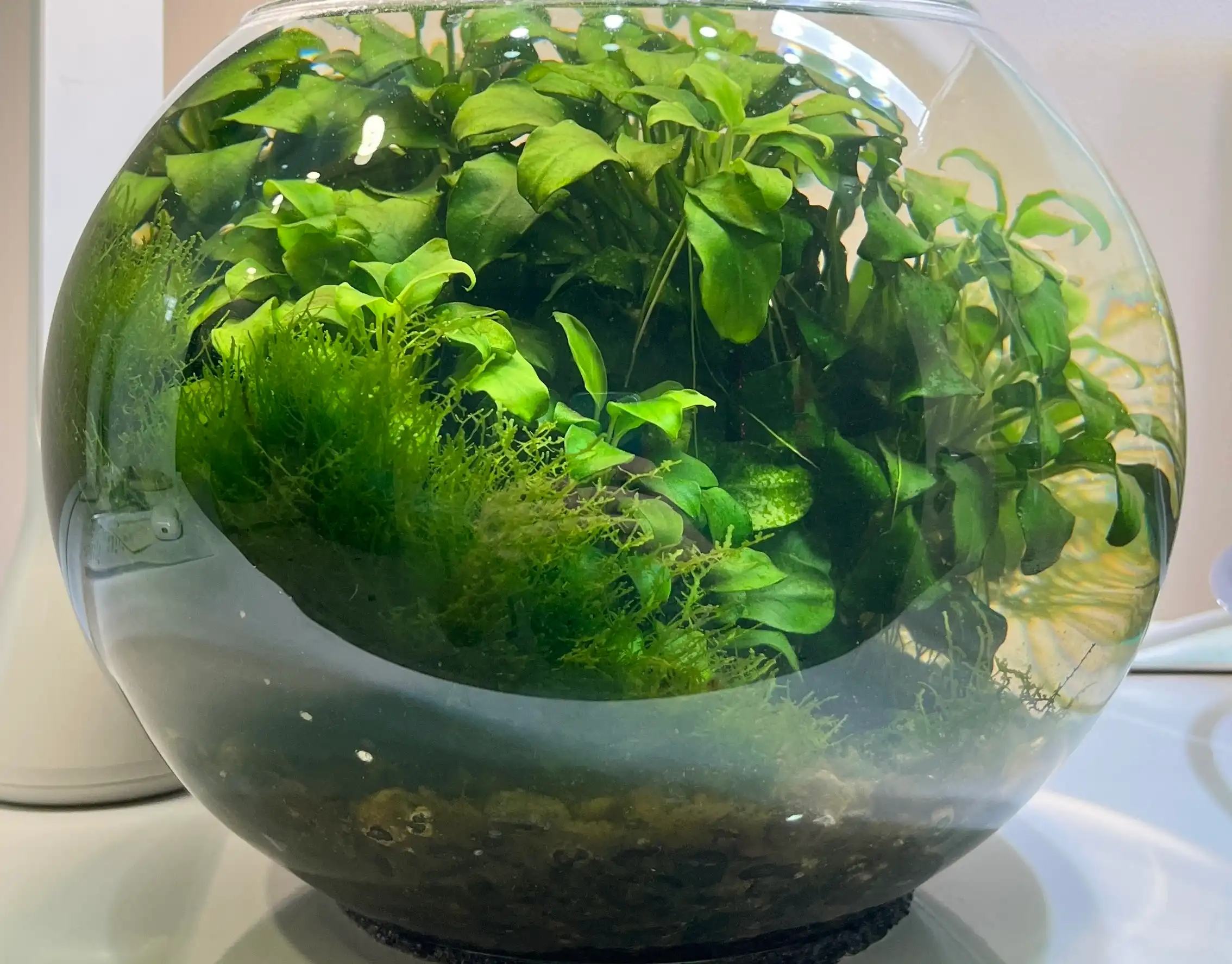
This guide will show you how to create a beautiful aquarium that requires almost no maintenance. No filter, no additional lighting, no CO₂, no liquid fertilizers. Just a vase with an Anubias — and minimal effort.
This guide is my journey to a beautiful low-maintenance aquarium. I can't promise identical results in different conditions, but I'm confident that by following it, you'll create your own living piece of nature at home.
What You'll Need
- A round vase or small aquarium (5-10 liters / 1-2.5 gallons)
- A large Anubias bush (Anubias Nana Petite or another variety)
- Fine gravel or quartz sand for planted tanks
- A small amount of aquasoil, can be used — 100-150 g
- Soft water (tap water works if it's soft in your region)
- RO water or very soft water (less than 3 °dGH) for top-offs to replace evaporated water
- Optional: hardness salts (remineralizer) if water is too soft
Step-by-Step Instructions
Step 1. Prepare the Base
Place gravel on the bottom in an even layer. Make a small depression in the center — a pocket. Fill this pocket with aquasoil, which will become a nutrient source for the Anubias roots. 1-liter bags are available for sale. The remaining soil will come in handy later. Just make sure to seal the bag well, and it won't spoil.
Step 2. Plant the Anubias
Place the Anubias bush in the center, with roots in the soil pocket.
Step 3. Add Water
Carefully add water so as not to disturb the substrate. You can use a tissue or watering can. Use soft water — this is important to prevent salt buildup in the system. If your tap water is too soft (GH < 4), add some hardness salts to reach 5-6 °dGH.
Step 4. Choose a Location
Place the aquarium in a spot with diffused light: near a window (but not in direct sunlight) or next to another aquarium. You can use a weak dedicated light. Anubias needs only minimal lighting. Avoid bright direct light, otherwise algae will appear.
Step 5. The First Months
During the first 1-2 months, do water changes once every 1-2 weeks (30-50% volume). This is the system stabilization period. After that, you can reduce the frequency of water changes.
Livestock and Feeding Rules
Can I Add a Fish?
Yes, but with caveats. You can add one, but only after the nitrogen cycle is established. A betta fish is an ideal choice for this type of aquarium. It doesn't require filtration, can breathe atmospheric air, and creates minimal load on the system. However, keep in mind: with a fish, the biological load will increase. Light algae growth on glass and surface film may appear.
What Else Can I Keep in This Aquarium?
Instead of fish, you can keep shrimp or snails.
Feeding Rules
Feed rarely and moderately — this is critically important. Overfeeding in a small volume will quickly lead to problems.
Optimal feeding:
- 2-3 worms once every 3-4 days, if using live food
- or 4-5 pellets, if using dry food
If possible — feed the betta with shrimp from your main aquarium. I used what's called shrimp culling.
Why This Aquarium Works
Biological Filtration
A large Anubias bush provides a large surface area for beneficial bacteria. They process ammonia and nitrites, performing the function of a filter. The larger the plant, the more effective the filtration.
Minimal Algae
No bright light — no algae. Anubias grows slowly and consumes few resources, so it's fine with weak lighting. Algae simply don't have enough energy and nutrients to develop under such light.
Gas Exchange
CO₂ comes from the air through the water surface and from fish respiration. In soft water conditions, carbon will be in the form of readily available carbon dioxide, not bicarbonates, allowing the plant to absorb it without high energy costs. This is enough for slow-growing Anubias. No additional gas supply is needed.
Nutrition
Microelements and potassium come from tap water. Macroelements (nitrogen, phosphorus) — from the fish, if present. Root nutrition is provided by the old aquasoil. The system is closed and self-sufficient.
Maintenance
Start (1-2 months)
- Water change once every 1-2 weeks, 30-50% (you'll likely change half the aquarium because of the small volume)
Adding Livestock
- After adding livestock, change water weekly, 30-50% for the first month
- If algae appears on plants, continue the same schedule for another month
When Balance is Established
- Water changes: can be greatly reduced — to once every 3-4 months or half a year. Changes are now only needed for cleaning
- Glass cleaning: practically not needed
- Trimming: not needed, Anubias grows very slowly
- Surface film removal, if necessary
Possible Problems and Solutions
Surface Film Appeared
This is normal when there's a fish. Remove it during water changes with a tissue or piece of paper.
Algae on Glass or Leaves
Most likely too much light. Move the aquarium to a darker spot.
Detritus on Leaves
A downside of no water flow. When cleaning, brush it off the leaves, let the debris settle, then collect with a siphon.
Yellow Leaf
Don't panic. Old leaves die off — this is normal. Just remove it. If young leaves are yellowing — check the lighting. If the aquarium has no livestock, by the end of the second year there may be a nutrient deficiency. Try adding a couple drops of micro and macro fertilizers and observe the response.
How Long Will This Aquarium Last
A better question is: how long before you need to intervene in this aquarium's life. If you did everything right, the first time you'll need to trim the Anubias will likely be in 2-3 years.
Optimal way to trim Anubias:
- drain half the water into a separate container
- move livestock there
- remove the Anubias and place in the same container
- perform partial trimming of the Anubias
- siphon out the old soil
- add new aquasoil
- replant the Anubias
- add water (bacteria will remain in substrate and on the plant)
- return livestock from the holding tank after a week
Key Success Factors
- Patience. Don't rush the aquarium. Don't add equipment at the first signs of problems. The system will stabilize on its own if given time.
- Moderate light. Too much light is the main enemy. It's better to under-light than over-light.
- Soft water. Don't overload the system with minerals. Use soft water for changes.
- Proper start. Large healthy bush + root nutrition = success. Don't skimp on the plant.
- Minimal intervention. The less you do, the better. This system works precisely because of non-intervention.
Conclusion
This aquarium is direct proof: beauty doesn't require sacrifice, it just needs a little time. This little one can survive a move, your vacation, and even a temporary loss of interest in the hobby. The perfect option for those who want a piece of the underwater world without obligations.
Give it a try — and see for yourself that you can create a beautiful aquarium without major investments of effort and money.
Want to discuss the article? Go to our Facebook page.