A remineralizer in Samomes is a ready-made formula for preparing a mineral mixture with precisely calculated component proportions. It contains all necessary data: which reagents to use and in what quantities to obtain a composition for increasing water hardness and creating optimal parameters for your aquarium plants.
Types of Remineralizers
In Samomes, all remineralizer recipes are presented as dry mixtures, so unlike the Recipes section, water is not selected in the reagents by default. However, you can still add it from the list.
Main Features of Working with Remineralizers
What you can do:
- Create remineralizer recipes from any reagents
- View the composition of any remineralizer
- See exact concentrations of all elements
- Calculate required reagent masses
- Copy and modify existing recipes
- Create your own remineralizers of any complexity
- Add new reagents if they are missing
Remineralizer Information
Each remineralizer contains:
- List of reagents with exact masses
- Hardness increase table by elements
- Hardness increase values of the entire mixture or solution
- Ca/Mg ratio of the remineralizer
- Mixture concentration table
- Water change concentration charts
- Component solubility information
- Dosage tables for different dosages
Understanding the Results
Let's look at an example with the Samomes Gh+ remineralizer.
Reagent List
Complete list of chemical components with exact masses of each reagent in grams.
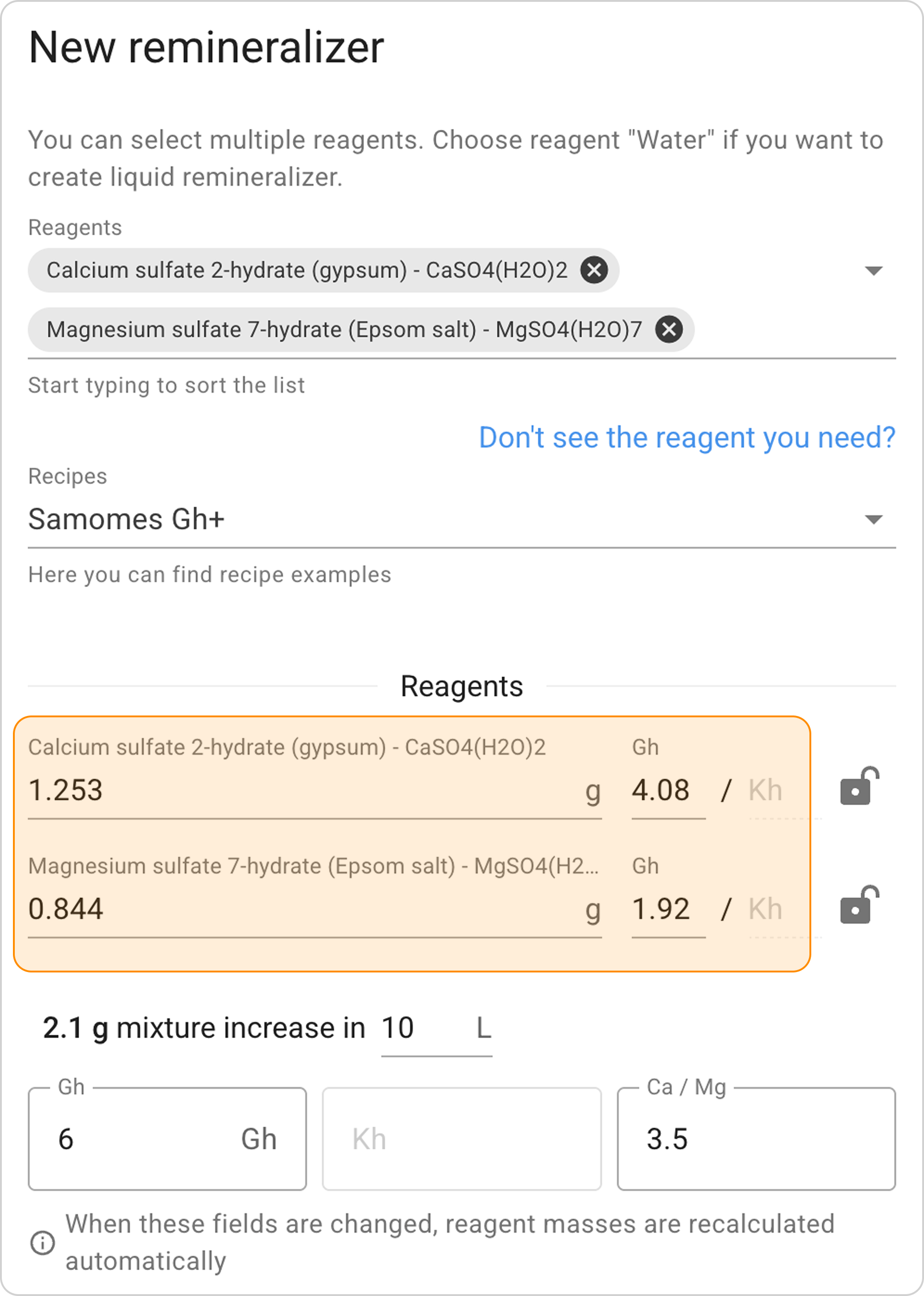
In our case, the "Reagents" field specifies:
- mass and Gh of calcium sulfate dihydrate,
- mass and Gh of magnesium sulfate heptahydrate.
Key Parameters of the Remineralizer Being Created
The section highlighted in the orange frame is the recipe control center — here you set the desired water characteristics, and the system calculates how much of which reagents to use.
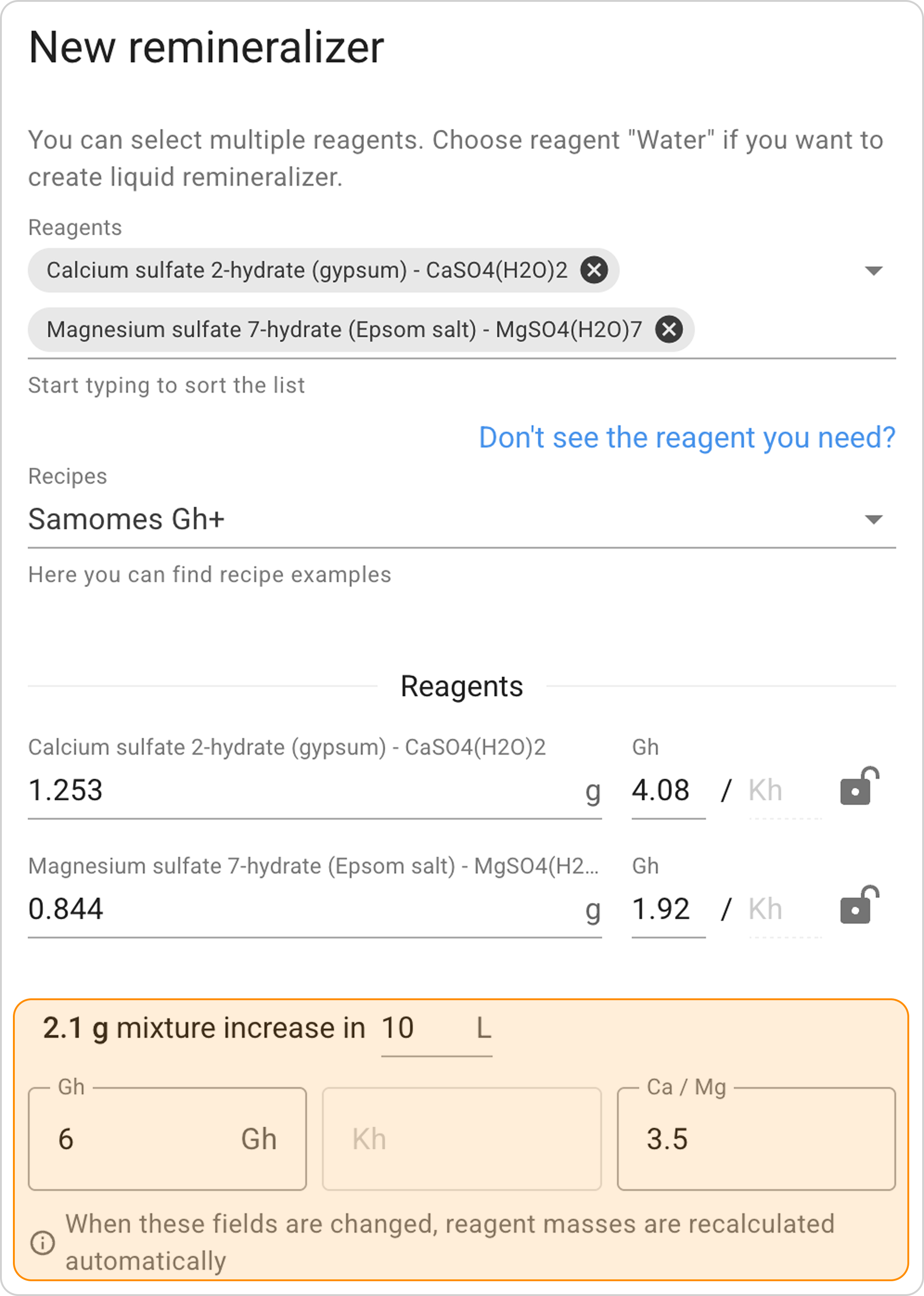
"2.1 g of mixture increases in 10 L"
This means that if you take 2.1 grams of finished dry mixture (consisting of gypsum and Epsom salt in calculated proportions) and dissolve it in 10 liters of water in the aquarium, you will get water with the specified hardness parameters.
Parameter fields:
- GH = 6 — general hardness will increase by 6 units
- Kh (empty field) — carbonate hardness will not change, as the reagents used (gypsum and Epsom salt) do not affect Kh
- Ca/Mg = 3.5 — the calcium to magnesium ratio is 3.5:1
Information message
"When changing these fields, reagent masses are recalculated automatically" — means that if you change any of these parameters (for example, want Gh = 5 instead of 6, or Ca/Mg ratio = 4), the system will automatically recalculate the necessary masses of gypsum and Epsom salt to achieve the new target values.
Mixture Concentration Table
This table shows the percentage composition of the finished dry mixture of the remineralizer by elements.
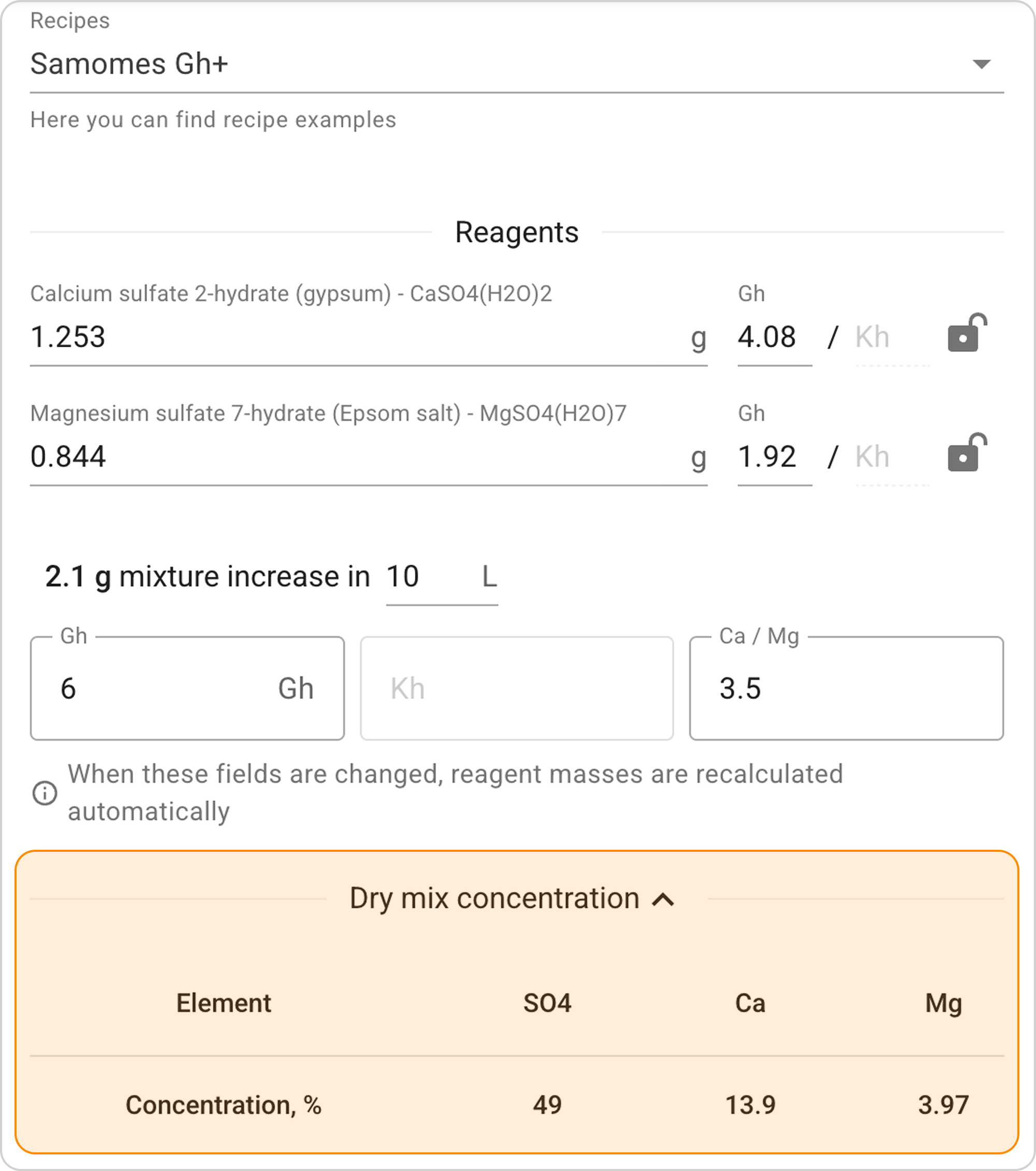
Elements in the table:
- SO4 (sulfates) — 49%
- Ca (calcium) — 13.9%
- Mg (magnesium) — 3.97%
What these numbers mean:
Out of the total mixture mass (2.1 g in this example):
- Sulfates constitute 49% — this means the mixture contains approximately 1 g of pure sulfate ions
- Calcium constitutes 13.9% — about 0.29 g of pure calcium
- Magnesium constitutes 3.97% — about 0.08 g of pure magnesium.
Practical Application
This information is useful for:
- Comparing with commercial analogs — you can compare the composition of your DIY remineralizer with branded analogs
- Mixing quality control — when preparing large batches
- Calculating the impact on total water mineralization (TDS)
- Analyzing anion balance in the resulting water
Note that sulfates predominate, as both main components (gypsum and Epsom salt) are sulfate salts.
Water Change Concentration
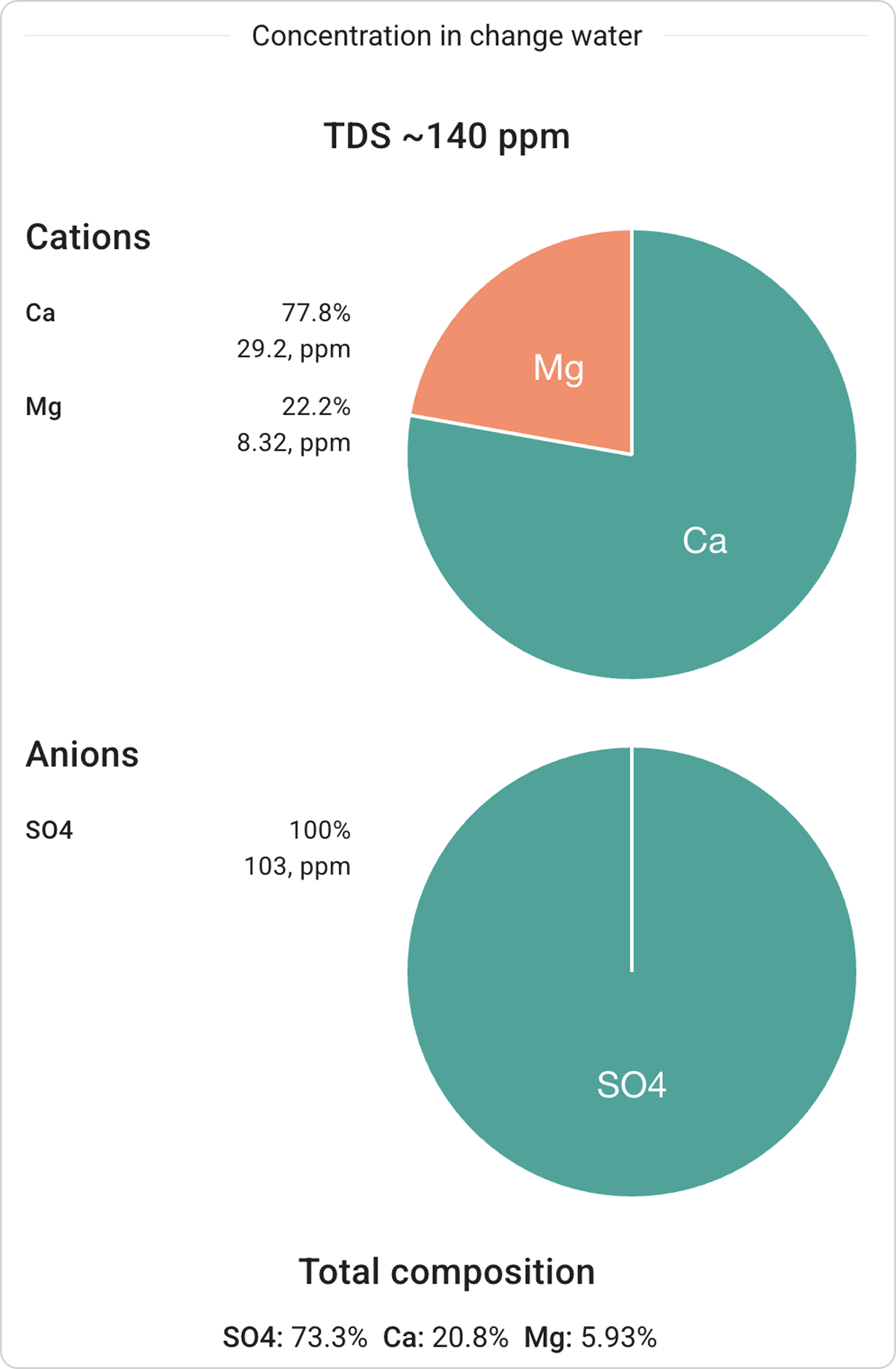
This section shows the mineral composition of water obtained after dissolving 2.1 g of remineralizer in 10 liters of water: TDS ~140 ppm
Total mineralization (total dissolved solids) is about 140 parts per million. This is a moderate mineralization level suitable for most aquarium plants and fish.
Cations (positively charged ions):
- Calcium (Ca) — 77.8% of all cations (29.2 mg/L)
- Magnesium (Mg) — 22.2% of all cations (8.32 mg/L)
The Ca:Mg ratio is approximately 3.5:1, which is considered optimal for aquarium plants.
Anions (negatively charged ions):
- Sulfates (SO4) — 100% of all anions (103 mg/L)
This means that only sulfate ions are present in the water, which is characteristic of remineralizers based on gypsum and Epsom salt.
Overall water composition:
- SO4: 73.3% — sulfates constitute the main part of all dissolved substances
- Ca: 20.8% — calcium in second place
- Mg: 5.93% — magnesium occupies the smallest share
This information helps you understand exactly what water you will get for changes and ensure that the mineral balance is suitable for your plants and fish.
Portions Table
This table is a practical reference guide for using the remineralizer in various situations. Portions are precisely measured (weighed) portions of substances, a term from chemical practice emphasizing the importance of accurate dosing to obtain reproducible results. The dosage table tells you: "To get the desired result, take (weigh out) exactly this many grams of each substance". This guarantees reproducibility and accuracy of results.
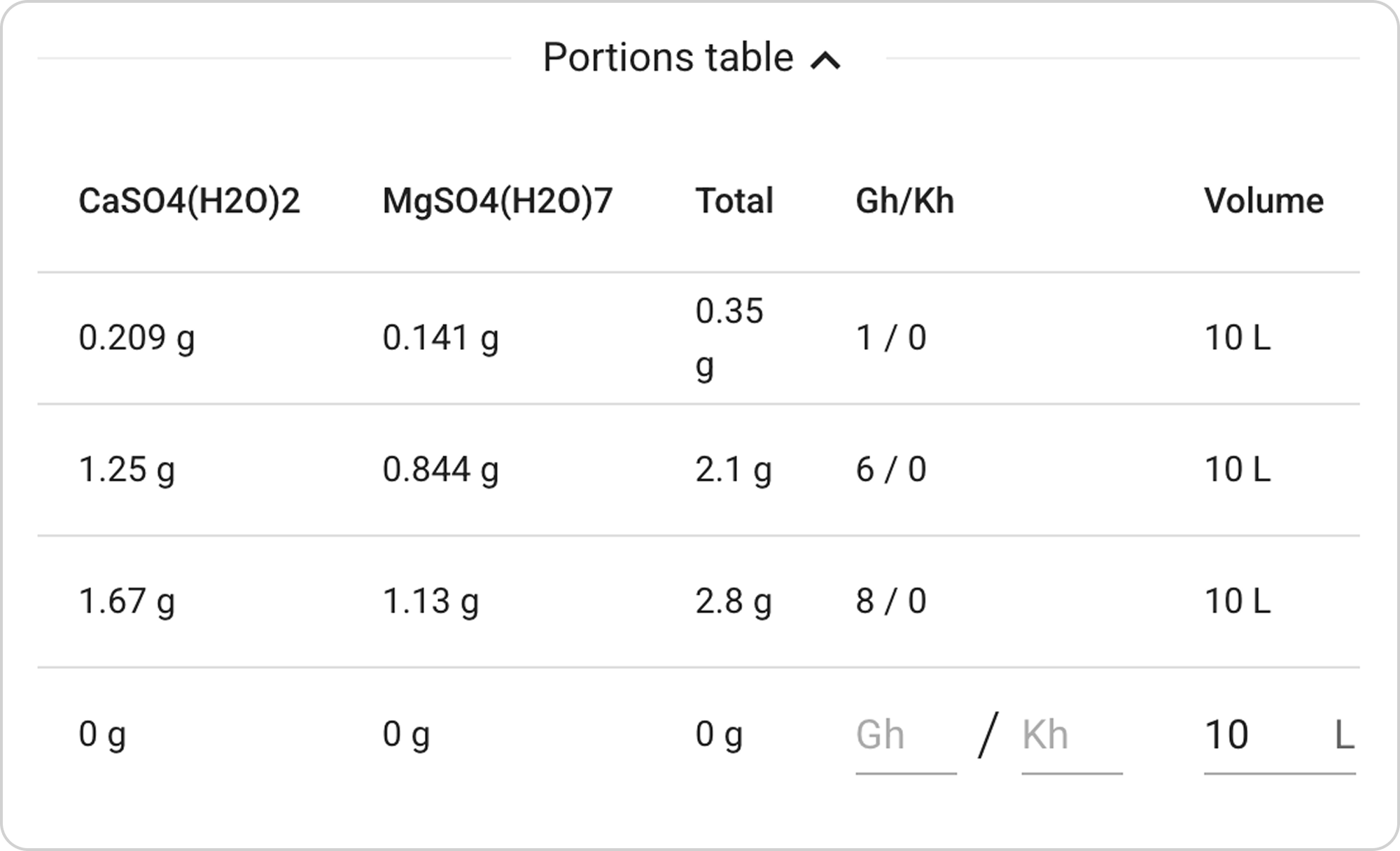
Table columns:
- CaSO4(H2O)2 — dosage (exact mass) of gypsum in grams
- MgSO4(H2O)7 — dosage (exact mass) of Epsom salt in grams
- Total — total mixture mass in grams
- Gh/Kh — by how many units hardness will increase
Ready-made remineralizer options (first three rows):
- 1/0 — to increase by 1 GH in 10 L: weigh out 0.35 g of mixture (0.209 g gypsum + 0.141 g Epsom salt)
- 6/0 — to increase by 6 GH in 10 L: weigh out 2.1 g of mixture (1.25 g gypsum + 0.844 g Epsom salt)
- 8/0 — to increase by 8 GH in 10 L: weigh out 2.8 g of mixture (1.67 g gypsum + 1.13 g Epsom salt)
These three ready-made options cover the most common aquarist needs — from light mineralization (1 GH) to medium water hardness (8 GH). You simply select the needed row and get ready dosages for weighing, without additional calculations.
Custom row (fourth):
Fields for entering your parameters. For example, if you need to increase GH by 5 units in 30 liters of water, you enter these values and get exact dosages of each component for weighing.
Practical Application
This table is especially convenient when you don't pre-mix components but dose them separately. In home conditions, this is often exactly how it's done, since evenly mixing dry powders of different fractions is quite difficult.
Mixture Preparation
This section is intended for those who want to prepare a large batch in advance of finished remineralizer by mixing dry components.
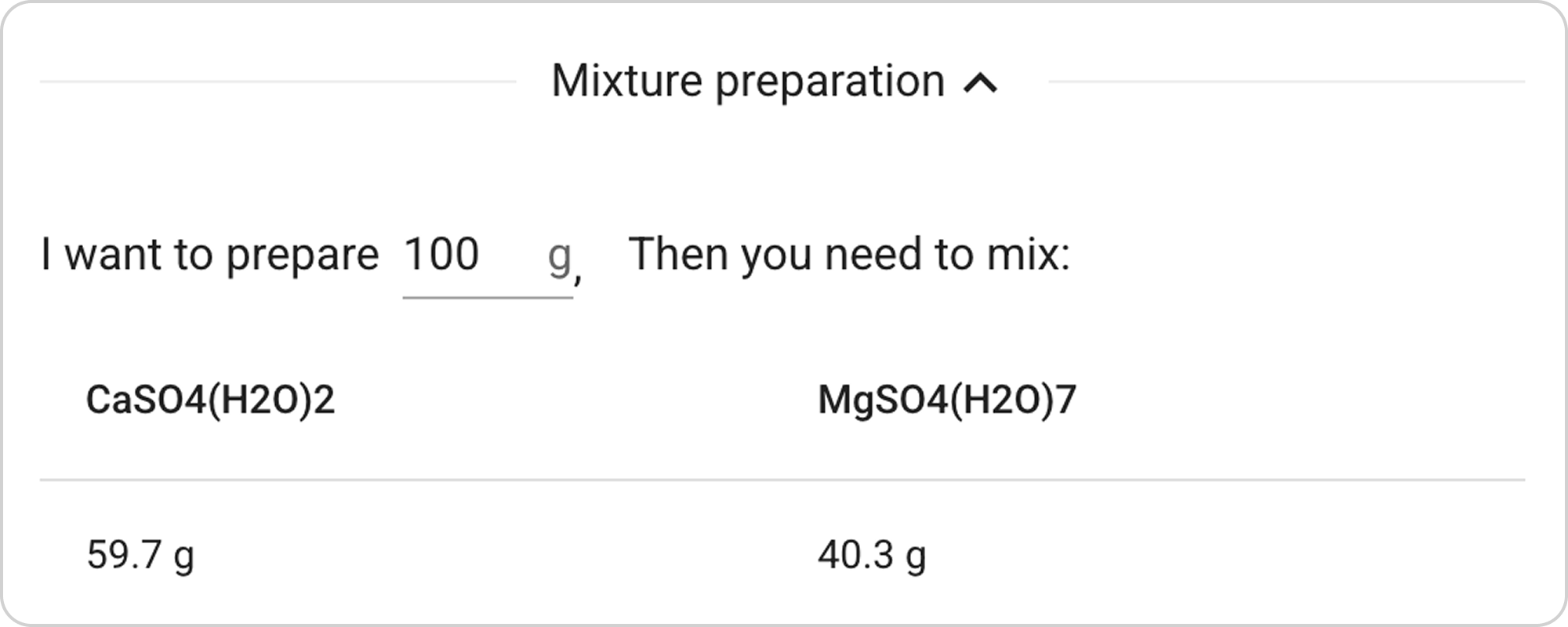
Operating principle:
- Enter the desired mass of finished mixture. In our example: enter the value "100" g.
- Get exact proportions of each component for mixing.
Calculation for 100 g mixture:
- CaSO4(H2O)2 (gypsum) — 59.8 g
- MgSO4(H2O)7 (Epsom salt) — 40.2 g
- Total: 100 g of finished mixture.
This feature is useful when you want to:
- Prepare a stock of remineralizer for a long time
- Mix a large batch to save time
- Obtain a homogeneous mixture using special equipment (mixer, shaking)
Important features:
- Proportions are preserved regardless of mass (you can enter 300 g, 500 g, or any other amount)
- Quality mixing requires special effort, as it's quite difficult to evenly mix powders at home
- Finished mixture is then used according to the dosage table
Alternative: Many aquarists prefer separate dosing of components, avoiding problems with uneven mixing.
Solubility Control
- The system automatically tracks maximum solubility
- A warning will appear if the limit is exceeded
- Solubility depends on water temperature
What to Do Next
After creating a remineralizer, you can:
- Use in the "Hardness" section for planning water changes and selecting Gh and Kh
- Use in the "Dosing" section for planning water ionic composition
- Calculate dosages for different tank volumes
- Create more complex multi-component mixtures
Related Materials
- How to Use Ready-Made Remineralizer Recipes?
- How to Adapt a Ready-Made Remineralizer Recipe?
- How to Create a Two-Component Remineralizer?
- How to Create a Three-Component Remineralizer with Different GH and KH Ratios?
- How to Create a Liquid Remineralizer?
- How to Fine-Tune Dosing in Samomes?
- How to Use the Fertilizer Dosing Schedule in Samomes?